
Table of Contents
Summary
This article compares coworking spaces in South Delhi against the emerging North West Delhi option in Rohini, Delhi. It covers real seat pricing, commute time, parking problems in hubs like Nehru Place, and a cost per productive hour calculation that most coworking content ignores. It closes by showing why AlleyWork in Rithala, North West Delhi offers a stronger overall fit for founders and teams based in that belt, thanks to lower cost, shorter commute, and built in training support.
Key takeaways
South Delhi coworking seats cost roughly eight thousand to over twenty thousand rupees a month, while Rohini and Pitampura seats commonly start around six and a half to eight and a half thousand rupees for similar amenities.
Parking is a documented, recurring problem in Nehru Place and Bhikaji Cama Place, confirmed by both resident reviews and Delhi civic authorities.
A team commuting daily from Rohini or Pitampura to South Delhi can lose over two hundred and fifty person hours a month just in transit, a cost that never shows up in a standard rent comparison.
Client perception tied to a South Delhi address matters less today, since most early meetings happen over video or at the client’s own location.
AlleyWork in Rithala, North West Delhi combines a professional coworking setup with real training in marketing, sales, and presence, a gap no South Delhi coworking space currently fills.
Introduction
If you are searching for a coworking space in South Delhi right now, here is the direct answer first. South Delhi offers strong brand value and client proximity, but it comes at a real cost in rent, parking, and daily commute time. A growing number of founders in Rohini, Pitampura and the wider North West Delhi belt are choosing to skip rental costs completely. They are doing this without giving up on having a setup. This article takes you through both sides honestly. It includes numbers so you can make your own decision, for your team. You don’t need to trust a listing page. You can trust what you read here.
Why South Delhi became the default choice
For years, if you told someone you had an office in Nehru Place, Saket, or Green Park, that address did some of the talking for you. These pockets grew into business hubs decades ago and they still carry that weight today.
Nehru Place is home to IT companies and hardware markets and sits close to three metro lines, and coworking operators there market that connectivity heavily, including 91Springboard’s Nehru Place hub, which highlights metro access and nearby dining as its main draw. Saket sits next to Select Citywalk and a cluster of corporate towers. Green Park and Hauz Khas attract a younger, creative crowd along with design and media businesses. Bhikaji Cama Place and Okhla round out the list with a mix of consulting firms and manufacturing offices.
None of that is wrong. It is just half the picture.
What a South Delhi coworking seat actually costs you
Pricing across South Delhi hubs varies a lot depending on the exact location and seat type. According to a current Delhi coworking pricing guide, premium business districts such as Connaught Place, Nehru Place, and Aerocity sit at the higher end of the market compared to emerging commercial areas.
Based on live listings across South Delhi hubs, dedicated desks in Nehru Place and Saket run from about eight thousand rupees to over twenty thousand rupees per seat per month. Private cabins push higher, often between twenty five thousand and thirty five thousand rupees per seat in premium buildings. Meeting room rentals add further cost on top of a base membership.
That number alone tells only part of the story. The real cost shows up once your team actually starts commuting.
What nobody tells you before you sign in South Delhi

This is the part every directory site skips, because directory sites are built to list options, not to warn you about them. Here is what shows up again and again once you look past the listings.
Parking is a genuine daily problem in Nehru Place. Local residents describe the same complaint repeatedly on property review platforms, where one long time resident notes that parking is a huge problem and cars often end up parked a full lane away from their building. Delhi’s civic authorities have also flagged Nehru Place and Bhikaji Cama Place as chronic parking trouble spots that still lack a permanent, timeline bound fix.
Traffic on the Outer Ring Road near Saket and Nehru Place regularly turns a fifteen minute drive into forty five minutes during office hours. Anyone commuting from outside South Delhi feels this daily, not occasionally.
And then there is the commute itself. If your team lives in Rohini, Pitampura, Ashok Vihar, or anywhere in the wider North West Delhi belt, reaching Nehru Place or Saket during peak hours can take forty five to seventy five minutes one way by road. That is a lot of hours spent sitting in traffic instead of working.
An industry observation worth thinking about. Workspace consultants who study coworking demand across Delhi NCR always say that location decisions made for prestige without looking at where the real team lives are one of the most common regrets that founders have in the first year, after signing a lease.
The real number nobody calculates, cost per productive hour
Every South Delhi listing shows you the rent. None of them show you what that rent actually costs once you add the hours your team loses getting there.
Here is a simple way to see it. Take a team of six people living across Rohini and Pitampura, working out of a Nehru Place coworking space.
Average one way commute during peak hours, about sixty minutes.
Round trip daily commute per person, about two hours.
Across six people, that is twelve person hours lost every single day, just in transit.
Over a twenty two working day month, that adds up to more than two hundred and fifty person hours spent commuting instead of building the business.
Add fuel or cab costs on top, and a seat that looked like it cost twelve thousand rupees a month starts looking a lot more expensive once you count what it actually takes to reach it and leave it every day.
South Delhi versus North West Delhi, side by side
| What matters to a founder | South Delhi (Nehru Place, Saket, GK) | North West Delhi (Rohini, Pitampura) |
| Dedicated desk price per seat per month | Roughly eight thousand to twenty thousand rupees | Roughly six and a half to eight and a half thousand rupees |
| Private cabin price per seat per month | Roughly twenty five to thirty five thousand rupees | Meaningfully lower for a comparable furnished cabin |
| Typical peak hour commute for a North West Delhi based team | Forty five to seventy five minutes one way | Under fifteen minutes for locally based teams |
| Parking availability | Frequently cited as a daily problem, especially in Nehru Place | Generally easier, with dedicated space at newer centers |
| Metro access | Strong, multiple lines depending on hub | Strong via Rithala, Rohini West, Rohini East, and Netaji Subhash Place |
| Client perception | Established, high prestige address | Improving fast as remote and hybrid client meetings become the norm |
| Growth support beyond the desk | Mostly limited to networking events | Structured training in marketing, sales, and presence at select spaces like AlleyWork |
This table is not meant to declare one side the winner. It is meant to show you exactly where the real tradeoffs sit, so the decision becomes about your team, not about habit.
Why North West Delhi is becoming the smarter choice for a growing number of founders
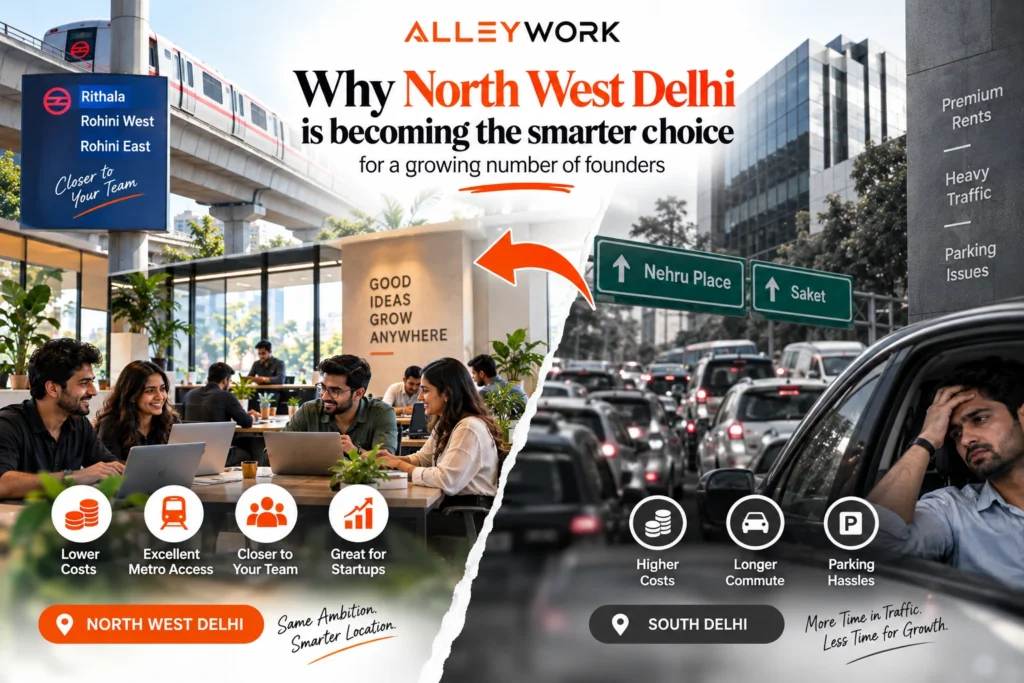
Rohini, Pitampura, Ashok Vihar, Shalimar Bagh, and Mangolpuri are not new areas. What is new is how many founders are realizing they no longer need to pay a South Delhi premium to get a serious, professional workspace.
Seat pricing here is meaningfully lower. Even large aggregator listings for the area, such as myHQ’s Rohini coworking page, confirm plans starting well below South Delhi’s entry price, alongside strong metro access to Rithala and Rohini West. A separate comparison of Rohini coworking spaces points out plainly that rents in Rohini are lower compared to South Delhi or Central Delhi, making it a natural fit for startups and small businesses watching their burn rate.
Metro access is strong too. Rithala, Rohini West, and Rohini East sit on the Red Line, with Netaji Subhash Place giving Pink and Red line access to Pitampura. For a founder whose team already lives in this belt, the daily commute drops from over an hour each way to a walk, a short auto ride, or a couple of metro stops.
The honest objection people raise is client perception. Does working out of North West Delhi make you look less established to a client or an investor? In practice, this concern matters far less today than it did even five years ago. Most early client conversations and even a lot of investor meetings now happen over video calls. When an in person meeting does happen, it usually takes place at the client’s office or a neutral location, not at your desk. What actually builds credibility today is a clean, well designed space, a reliable internet connection, and a team that shows up prepared, not the pin code on your visiting card.
The gap that matters more than the address
A desk, a chair, and free WiFi do not grow a business. Skills do. Systems do. The right people around you do.
Walk into most South Delhi coworking spaces and you get exactly what every other space offers, a seat, a printer, and a pantry. That is table stakes now, not a differentiator.
AlleyWork in Rithala was built around a different question. Instead of asking how many amenities can we list, the team asked what does a founder in their first hundred days actually need beyond a place to sit. That thinking shows up across every part of the space, from the dedicated desks built for solo builders, to private cabins for small teams that need a closed door, to meeting rooms designed for client calls and pitches, to a full virtual office setup for founders who need a registered Delhi address without leasing space.
AlleyWork runs regular sessions on digital marketing and SEO that go beyond surface level advice, practical sales training for people trying to close their first ten clients, and work on presence and communication for founders about to walk into bigger rooms than they are used to. It also functions as a genuine incubator style community, where introductions to other founders and occasional investor conversations happen naturally because everyone in the room is trying to build something.
This is the single biggest content and product gap across every South Delhi coworking option available today. Nobody else is combining a workspace with a real growth system.
A short founder story
Rohan, who runs a small B2B software team, spent his first year working out of a shared office in Nehru Place because that is what everyone told him to do. His team of four lived across Rohini and Pitampura. Every day started with an hour long commute each way, and by the time everyone settled in, a third of the morning was already gone.
He moved his team to AlleyWork in Rithala after realizing the math simply did not work anymore. The commute dropped to under fifteen minutes for most of his team. The rent came down too. But the bigger shift, in his words, was sitting in a room with other founders who were figuring out the same sales and marketing problems he was, and having an actual structured way to learn from that instead of picking things up randomly.
His team now spends those recovered hours on client work instead of the Outer Ring Road.
How to actually decide, not just compare
Skip the pros and cons list for a second and ask yourself three direct questions.
Where does your team actually live, and how much of their day disappears into commuting right now.
How often do you genuinely need to be physically present in South or Central Delhi for a client or investor, versus how often that meeting could happen over a call or at their office instead.
Are you looking for a place to simply sit and work, or are you looking for a space that actively helps you grow as a founder.
If your team works in South Delhi and you have client meetings often choosing a coworking space in South Delhi makes sense. That’s an fair decision.. If your team is actually based closer to North West Delhi and you’re still paying South Delhi prices just because you’ve always done it that way then the numbers don’t add up. The cost isn’t justified. It’s time to look at options like AlleyWork. The math is better. The growth support is stronger. It’s a move, for your team.
Frequently asked questions
Is South Delhi coworking worth the higher price for a new startup
It depends entirely on where your team lives and how often you meet clients in person there. If both point toward South Delhi, the price can be worth it. If your team commutes in from outside the area daily, the true cost is higher than the rent alone suggests.
What is the average commute time from Rohini or Pitampura to Nehru Place or Saket
During peak hours, this commonly runs between forty five and seventy five minutes one way by road, based on typical Outer Ring Road traffic patterns.
Is parking really a problem in South Delhi coworking hubs
Yes, particularly in Nehru Place and Bhikaji Cama Place, where both local residents and civic authorities have repeatedly flagged parking shortages as an ongoing issue.
How much does a coworking seat cost in Rohini compared to South Delhi
A dedicated desk in Rohini typically starts around six and a half to eight and a half thousand rupees a month, compared to eight thousand to over twenty thousand rupees in South Delhi hubs like Nehru Place or Saket.
Does office location in Delhi actually affect how clients see your business
Less than it used to. Most early client interactions now happen over video, and in person meetings usually take place at the client’s location rather than yours. A well designed space and a prepared team matter more than the pin code.
What makes a coworking space more than just a desk and WiFi
Access to real skill building, meaning practical training in marketing, sales, and communication, along with a community of other founders solving similar problems. This is the part most coworking spaces skip entirely.
The bottom line
South Delhi earned its reputation, and for teams already based there, it still makes sense. But for founders and teams living across North West Delhi, the daily commute, the parking stress, and the higher rent add up to a cost that rarely gets talked about honestly.
AlleyWork in Rithala was built for exactly this gap, a professional space at a fraction of the commute and cost, backed by real training and a community that is actually trying to help you grow, not just rent you a chair. You can read more about the space and its story on the AlleyWork about page, or check the FAQs for quick answers on plans and pricing.
If you want to see the difference for yourself, book a tour or a day pass at AlleyWork and bring your team in for a day before deciding anything.
About the author
This article is written by the AlleyWork editorial team, based in Rithala, North West Delhi. The team works closely with AlleyWork’s founders and members every day, and draws on that first hand exposure to founder decisions, workspace trends, and the North West Delhi startup ecosystem when writing on topics like this one. For questions about this article or about AlleyWork, reach the team at hello@alleywork.com.
A quick note on the internal links used here. They point to live pages on alleywork.com, including the about page, dedicated desks, private cabins, meeting rooms, virtual office, FAQs, and the contact section. Swap in the exact URL slugs your live site is using at publish time, since a couple of these have shifted between the WordPress build and earlier versions of the site, and a broken internal link will hurt this page more than a missing one.